Monday, July 28, 2014

El resumen / Reading Activity


En la clase de escritura nuestro profe nos pidió escribir un resumen de un ensayo de Octavio Paz. La destreza de resumir es algo que mis estudiantes practican con frecuencia en mi clase y por eso me interesaba averiguar cómo los profes de Middlebury la enseñarían. A mí me gusta la actividad muchísimo porque sirve para alcanzar tres objetivos: los estudiantes reciben la repetición necesaria para adquirir vocabulario nuevo por medio de leer tanto como escribir; tienen que analizar un texto para identificar el propósito del autor, el mensaje, a quien se dirige el texto, y los detalles y, por fin, tienen que resumir, un pocas palabras, la información pertinente. Sin embargo, mi profe extendió la actividad con dos actividades que, en mi opinión, sirven para hacer el ejercicio uno en el que los estudiantes pueden colaborar y reflexionar sobre su trabajo antes de entregarlo y así se aprovecharán más del trabajo. Sé que usaré esta actividad en mis clases en el año que viene y quería escribirla para aclarar la estructura:


1) Primero, prepare dos textos breves (para las clases más avanzadas los textos pueden ser más sofisticados) y dos pruebas correspondientes que evalúan el entendimiento de las ideas principales (las ideas necesarias para la buena formación de un resumen) de cada lectura

2) Repase las características de un buen resumen con la clase y, por supuesto, muestre un ejemplo de un resumen bien hecho

3) Divida la clase entre dos grupos y asigne el primer texto a un grupo y al otro grupo el segundo. A Los estudiantes se les permita leer sólo las lecturas de su grupo.

4) Asigne a los estudiantes el trabajo de leer y resumir lo que han leído.

5) Dirija que los estudiantes de un grupo intercambien sus resúmenes con los estudiantes del otro grupo. Déles tiempo para leer los resúmenes y hacer preguntas.

6) Por fin, suministre la prueba. Después de que los estudiantes la terminen; repásela con la clase. La idea es que si el resumen está bien escrito, con todo el contenido imprescindible, los estudiantes la aprobarán. Si los estudiantes no la aprueben el que escribió el resumen sabrá la información que le falta y lo que debe incluir para mejorarla.

7) Pida A los estudiantes que usen las pruebas y los comentarios de sus compañeros para re-escribir el resumen.

Monday, July 21, 2014

La actuación en la clase

Estoy pasando el verano en Middlebury, Vermont dónde estoy estudiando en el programa de maestría de español. A partir de los helados, el paisaje y, claro, el programa, lo mejor de estar aquí es que hay muchos maestras como yo y es una gran oportunidad para compartir ideas y estrategias para emplear en la aula. Esta noche, mientras cenábamos, una amiga mía me contó una práctica que ha aprendido a través de las jornadas de pedagogía que tienen aquí en la universidad (desgraciadamente, no estuve yo en la jornada pero, ¡tuve que entregar un ensayo!). El objetivo es adquirir el vocabulario por medio de repeticiones. (Por lo general, estoy a favor de hacer las repeticiones yo misma, sin embargo, como yo enseño en la escuela intermedia, hay que variar las actividades para que los estudiantes no se aburran.) La técnica mezcla un poco de las clases de actuación con las clases de lenguaje y consiste de lo siguiente:
 1) Pedir que los estudiantes caminen alrededor de la clase. Mientras caminan hay que mirar a uno y otro directamente en los ojos.
 2) Después de un par de minutos, decirles que tienen que mirar a uno y otro con caras que usted les mande. Por ejemplo, puede decirles “Ahora, quiero que todos pongan una cara enfadada” o “Ahora, pongan una cara triste”.
 3) Después de cuatro o cinco rondas así, mandarles repetir una palabra o una frase (algo que quiere que sepan) con una mirada especial. Así, puede mandar que los estudiantes repitan la palabra “bosque” mientras están mirándose con caras enojadas.
 4) Dirigir a los estudiantes a sentarse con un compañero y explicar que van a usar el vocabulario que están estudiando para hablar entre ellos. Sin embargo, tienen que hablar como si existiera una relación entre ellos. Por ejemplo, si la clase está aprendiendo la frase “se aleja de”, puede mandar que ellos repitan la frase como si ellos fueran madre e hijo o maestra y estudiante. Así, tienen que usar la entonación para transmitir el mensaje y, a través de las repeticiones, adquirirán el vocabulario. Si quiere extender la lección o desafiar a los estudiantes se puede pedirles crear una conversación con el vocabulario dado. Sin embargo, se debe tener en mente que la meta es que los estudiantes adquieran las palabra y no que las produzcan.

Tuesday, June 24, 2014

Adaptations of Newspaper Articles as Readings / School Rules

I work in an IB school and as such our administration routinely challenges us to ensure that our curriculum is relevant to current world events and that it encourages students to cultivate opinions regarding issues that affect them. I have tried to fulfill this expectation- with varying degrees of success- throughout this year as I have focused on developing as a Comprehensible Input teacher. Of the units that I have had the greatest success- measured in terms of engaging students in a meaningful discussion around issues that concern them and by the amount of language acquired by students- was one dedicated to the theme of "school rules." In order to provide my students with a context to discuss how and why schools develop rules, I began searching for current events that would be of some interest while at the same time provide the necessary comprehensible input. Here are three readings I adapted from newspaper articles for use throughout this unit. The articles led to some very lively discussions in the classroom regarding the various issues schools have to contend with when establishing rules. The first is about a school in England that fines parents for dropping students off to school late.

La Escuela Que Multa

The second has to do with the phenomenon of cyber bullying and whether or not schools have a responsibility to intervene in cases of online bulling.

Ciberacoso

The third and final article, reports on various characteristics of the public schools in Finland while comparing them to schools here in the United States.

El Secreto de Uno de Los Mejores Sistemas Educativos Del Mundo

Wednesday, June 18, 2014

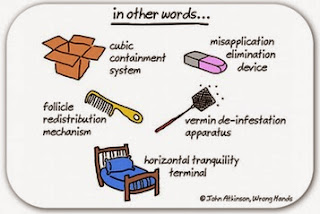
Circumlocution / The World Cup

Among the many reasons I enjoy teaching using the theory of Comprehensible Input is that it has opened up the possibility of discussing current events in the classroom. This past year I found that by giving students vocabulary structures and circling those structures sufficiently, I could introduce topics as far ranging as the death of Nelson Mandela to whether or not students should be fined for arriving to school late (a resounding "NO!" on the part of the students). And, while I was content to provide the input, it was great to see the urge in my students to take part in the discussion. I also saw them struggle when they wanted to communicate an idea or concept that they lacked the necessary vocabulary to express. Anyone who has tried to communicate in a language they have not yet mastered has experienced a similar frustration. It can lead to a lot of self conscious behavior which does little to promote language acquisition in the classroom. In order to help students how to get past this particular challenge, I began teaching my classes to use circumlocution skills to use what they know to express what they want to say. Of course, I did not go it alone but instead took to the Internet and, as usual, found some inspiring work by and for teachers. The lesson shared below is based on the work of a collective of teachers found Language Links 2006. The site includes a ton of ideas for cultural lessons, staying in the target language, and, you guessed it, circumlocution! It's a great resource and really worth taking the time to explore. The lesson I'm sharing here has to do with The World Cup in Brazil and whether or not developing countries should host international sporting events because of the cost. I'm sure that my students are going to want to weigh in on this one but I'll need to get them there by giving them the skills they need to be able to approach this topic in the target language. After introducing the topic to the students, I'll start the lesson by explaining some guidelines for getting around those words that you need but don't have. Suggestions include classifying the word as either a person, place, thing, or idea, stating what the object is not, and explaining who would be using it and to what end. I then put together some pictures for students to practice describing in pairs. The idea (which came to me by way of our local high school department chair and is brilliant) is that one student sits with their back to the PPT slide and the other has student describes what they see. (Because the topic of this particular lesson is fairly sophisticated, I chose to include the English word along with the visual because I didn't want there to be any confusion as to what concept the students should be describing to their partners.) When the student with their back to the slide guesses the word correctly, both students stand up. I usually ask the students to share their descriptions in order to point out the ways in which students used their circumlocution skills to "get around" a word.

World Cup Circumlocution Edited

In the World Cup lesson below, I will follow this up with a paper version of the same activity.

Circumlocution World Cup Partner Work

Finally, I'll give the students a reading that discusses the topic in detail and provides multiple perspectives on the same issue, giving the students some background on which they can base their own opinions.

Where Should the World Play the Beautiful Game?

Wednesday, June 11, 2014

Perezosos / The Guardian

Ran into this guy in Costa Rica in 2007

I don't know how many people out there would agree with me on this but I believe that one of the greatest benefits of the "digital revolution" has been that the news has become interactive! I love the slideshows, videos, and blogs that online news sources provide. And none, in my opinion, is better at showcasing pictures from around the world than The Guardian.  Just check out today's selection!

I often try to incorporate these photos into lessons and earlier this year, right before we took the students to Costa Rica for spring break, I ran across the cutest slideshow I've seen to date on the website... Sloths! (Please click on this link. It's guaranteed to put a smile on the face of even the most exhausted teacher!) I put the photos in a PPT and used them as a basis for a discussion about what sloths ate, where they lived, etc. but, I really wanted to accompany it with a reading.

Well, I finally got around to it and you can download it below. It fits perfectly into our unit on Costa Rica and the environment and I'm looking forward to using it next year.

Of course, you can always extend the lesson with a little Movietalk:

Tuesday, June 10, 2014

Organizadores Gráficos


As the year winds down (we still have two weeks in DC!) I've begun to organize all my materials in preparation for next year. One of the things I've noticed as a teacher is that I gravitate much more towards reading than storytelling (something I need to work on for next year) in my classroom. It makes me so happy to see a classroom of language learners engrossed in a Spanish novel!  Still, I want to make sure that my students are getting all they can from the reading and, if I can reinforce some of those English Language Arts standards in the process, well, why not?! As usual I began with an internet search of graphic organizers that help students organize, interpret, and analyze the text. Here are three of some of the nicest collections I found for free:

This collection from Pomperaug Regional School District in Connecticut contains over 35 organizers in both Spanish and English and include organizers for reading comprehension, vocabulary development, interpretive and analytical skills, and study habits.

The site Organizadores Graficos has loads of organizers in Spanish with nice, clear charts and they allow you to download them for free. The best part is that you can modify them to suit your students needs.

Finally, Eduplace has a nice collection of organizers with fun graphics (I work in a Middle School where were all about the graphics!).

However, not content to to NOT remake the wheel, I decided I'd try my hand at making some of my own. Using this simple, clear and fantastic tutorial on how to use Pages on a Mac by Alice Keeler, I created three organizers. The first is designed to have students express and support an opinion, the second is for making predictions and, the last, is for making sensory observations. I'm looking forward to using them in the classroom and would love to hear any suggestions others might have for using graphic organizers in the classroom.


Organizadores Graficos by AnnaHenderson

Monday, June 9, 2014

Professional Development

Source: http://edtechreview.in/trends-insights/insights/605-professional-development-for-teachers-investment-or-cost
As a non-native speaking Spanish public school teacher who is a true believer in the power of effective professional development, I am constantly searching for teacher education that is steeped in both content and pedagogy. While I believe that the tide is turning for the better in terms of the variety, access and source of development opportunities, I still get frustrated with the one day workshop model which provides little in the way of sharing and/or reflection. In my search for some really interesting and meaningful professional development opportunities for the spring/summer, I've run across some programs that I thought were worth sharing. I think the opportunities below do a lot to address these issues. Some are local to me in DC and others require travel. If anyone has any experience with any of these opportunities or knows of any others, please feel free to comment and/or share.

ACTFL's Spring Webinar Series-- these might not be the best in terms of addressing my "one shot" complaint of mine but I think they're an easy way to get some PD in and they look like they might have some value! (Also, might be worth checking out if there are any PD opportunities in the form of MOOCs in Spanish content and/or pedagogy- I wonder if any Districts have figured out how to give credit for these...)

National Capital Language Resource Center and The George Washington University is hosting a Spanish Immersion Weekend! I've subscribed to them for some time and they offer some great resources in their newsletter alone.

Middlebury 4 Week Summer Program for Spanish Teachers-- Who better to get PD from than Middlebury?!

Bennington College- Their graduate language school is offering a weekend intensive language workshop in both French and Spanish. It's called Le silence et la voix or, in Spanish, El silencio y la voz. They don't have a website but you can check out the flyer below.


The World Affairs Council-Washington, DC again offers its week-long Summer Institute on International Affairs for Educators. This year's theme is "Realities & Revolutions: A comparative look at civil society and its pathway to change," which will be explored from a historical and comparative perspective. Expect an intensive week of expert speakers, hands-on practical application, and developing classroom resources. Participants will receive 40 professional development credits/hours; three (3) graduate credits are available through Howard University ($300 total). To register contact Amanda Stamp at education@worldaffairsdc.org or 202-293-2051.

NTPRS- This is the annual conference for TPRS (Teaching Proficiency through Reading and Storytelling) and, if you're not familiar with it, is a research based methodology for teaching languages that focuses on acquisition rather than learning. This means that teachers teach with the objective of students acquiring the language instead of learning about how the language works. The underlying philosophy is that students acquire language through compelling and comprehensible input in the target language. I was introduced to TPRS by a colleague at our local High School and I've found it to be the most intuitive and effective methodology that exists. Further, it's focus on reading allows language teachers to align their objectives with many of the objectives of English Language Arts thereby allowing us to creep out of the corner of the "elective course" just a little.

CARLA Summer Institutes-- hosted by University of Minnesota's Center for Advanced Research on Language Acquisition

iFTL Conference 2014 I attended the conference last year in San Diego and it was an awesome learning experience for me. The conference was filled with incredible educators throughout the country and tireless Carol Gaab who was never short of fun ideas for teaching. I would recommend this institute which as it both laid back and incredibly informative to anyone interested in learning about CI/TPRS.