Thursday, November 27, 2014

Highlights from ACTFL 2014 / Social Reading

Image taken from: http://bits.blogs.nytimes.com/2010/11/11/social-books-hopes-to-make-e-reading-communal/
Another great benefit of attending ACTFL was the exposure to a number of different teaching tools that I was previously unaware of. Before going any further, I think it's important to admit that as far as using technology in the classroom is concerned I am woefully behind. I began teaching with CI/TPRS two years ago and I have, since that time, have concentrated almost solely on the effective delivery of comprehensible input. However, I do understand the importance (and value) of taking advantage of the tools that technology has to offer and sought out sessions in San Antonio that would shed some light on some of the more effective apps/websites out there. The first really mind blowing (again, I'm new to this tech stuff) strategy/tool I learned about was social reading. Basically, the idea behind all social reading applications is that you provide a space for students to read, annotate, and comment on a text together thereby helping one another to decipher meaning and understanding. These tools are an obvious asset in the English Language Arts classroom but, I would argue they're even more valuable in the Foreign Language Classroom, especially when students are exposed to authentic texts. There are a number of social reading applications out there for you to explore in order to find which works best for you and your students. Some allow you to upload your own text and others require you to choose from a selection. Below are some of the social reading apps discussed at ACTFL (if anyone knows of any others, I'd love to hear about them):


(I've also included this June 2014 article on the best apps for classroom use. Many of which I'm unfamiliar with but hope to blog about my successes with them later!)

All of the presenters at the session on social reading I attended were World Language faculty members at a universities around the country and because they are in higher education not all of their ideas seemed to me to be readily adaptable to the middle school level. However, one of the panelists, Joshua Thoms from the University of Utah, described a project he and his students completed using classroom salon that I thought would be really fun to try with my own students.

(1) The activity is a group project and so the first step is to assign groups of four.
(2) Each group was assigned a different text and had to read the text using the Classroom Salon app. They were also instructed to annotate the selection and to comment on each other's work. (This step requires getting author's permission to use their text on Classroom Salon.)
(3) Groups then had to generate 10-15 different interview questions for the author of each text.
(4) Finally, the groups conducted Skype interviews with the author in the target language and those interviews were later played for the entire class.

I remember reading a blog post long ago about Cynthia Hitz doing a skype interview with her students and Mira Canion and thinking then how cool that would be to do with my own kids. We will be reading "Hija del sastre" by TPRS publishing later this year and I'm planning on bringing in some authentic texts about the Spanish Civil War and having students do the activity described above.

Wednesday, November 26, 2014

Highlights from ACTFL 2014 / Higher Order Thinking


I've just gotten back from ACTFL in San Antonio and I have a notebook full of ideas I wanted to share here for future use. My first session was given by Carol Gaab and was entitled "Inspiring Higher Order Thinking." I work in DC public schools and an entire section of our evaluation rubric is devoted to higher level thinking in class and so I was eager to attend. As always I found the presenter full of energy and with some excellent ideas. For this session, Gaab used her biography about Felipe Alou.
(1) She first discussed how she selected particular vocabulary words from the text by looking both for the major themes of the novel and the highest frequency vocabulary words. For this text, Gaab chose the word "dream."
(2) To reinforce the vocabulary, she gave students five examples of different types of dreams and asked session participants to distinguish between "waking dream" and "sleeping dream." For example, "Felipe dreams of joining the major leagues" would be classified as a "waking dream" or a "goal" and "Felipe dreamt there was a monster under his bed" is a "sleeping dream."
(3) In order to give students more opportunities to practice the vocabulary she gave students various sentences about the main character and students had to decide if each statement were "probably" or "possibly" true. I like this strategy which is very similar to Martina Bex's "This or That" activity and can be modified in a variety of different ways.
(4) Gaab then suggested personalizing the vocabulary. Asking the students questions like "Do you have a dream?" "Do you always dream the same thing?"
(5) Next, Gaab asked participants to indicate which of the following words could be used to describe a dream: Event, Opinion, Goal, Wish, Reality, Future. She suggested distinguishing between long-term goals and short-term goals and, to demonstrate, showed us an impressive video of one of her own ESL students discussing his long and short term goals on video.
(6) After this last activity, Gaab transitioned from talking about dreams to talking about stereotypes (all of this in preparation for the students listening to Martin Luther King Jr.'s "I have a Dream" speech). She introduced the word "judge" and asked students if they thought they were a judge. Anticipating that most would answer in the negative, she showed the audience several pictures depicting various stereotypes (an overweight woman, two goth kids, etc.) and asked us to write down three words describing each picture. She then asked us to share comments in order to see whether we commented on economic status, looks, age, etc., proving to us that we do in fact judge one another.
(7) Gaab followed up with a selection from the "I have a Dream" speech. She suggested giving the students a transcript while they listened and, ultimately, taking the script away after the second or third listen. I would also try to personalize the speech as much as possible and circle key vocabulary after each listen.
(8) As a post-listening/post-reading activity Gaab gave us several sentences and asked us to distinguish the sentences as either something MLK would say or would not say.

All and all I thought it was an excellent session and took away a ton of ideas. We are gearing up to read "Los Baker van a Perú" after the holiday and I'm looking forward to developing some higher order thinking with this text.

Wednesday, October 15, 2014

Grading Writing / Correction Grid

Lately I've been preoccupied as to how to provide feedback to students on written assignments without killing myself grading. (In an ideal world I would focus solely on listening and reading in the lower levels but I've come to realize that parents and administrators want to see proof that their students can communicate in the language.) I asked a colleague of mine how she manages to give meaningful feedback quickly on assessments like timed writings. She suggested focusing on one aspect of the writing, i.e. subject-verb agreement or gender agreement, and quickly scanning the writing, highlighting (with an actual highlighter) any errors in the one area you've decided to focus on. She also suggested having students go through each other's work doing this process with the highlighter for you. Brilliant.

While she was explaining this technique to me, I remembered a Correction Grid I found years ago on TES. It's used to fix writing errors by assigning common mistakes a number. It's really useful in terms of helping students self-correct writing mistakes and to facilitate peer-editing. I thought if I were going to take my colleague's advice, I could use this grid to help students identify which aspects of their writing I/they would focus on when giving feedback. I've re-written the Correction Grid and am sharing it below. The original can be found here.


Saturday, October 11, 2014

Silent Discussion

Finally, a long weekend and time to blog! I'm full of activities I want to write about. The first, called "Silent Discussion", is an activity I discovered while walking through the hallways of my school. Posted on the walls outside of a history classroom, I saw large sheets of paper on with a question in the center around which were all sorts of student responses and commentaries. Thinking this would be a great way to generate responses to some of the higher-level thinking questions in my class, I asked how it worked. Below are the instructions:


  • First, put students in groups of three or four (no more than four and no fewer than three) and give them a large sheet of paper and markers. 
  • Give students a question that they will write in the middle of the paper. 
  • Explain that they will be silently discussing, in writing, their thoughts on this particular question.
  • Instruct students to respond to the questions themselves and comment on at least two of their partners' responses. 


I love this activity because it gets students producing in the target language (which is not as important for me in lower level classes but anyone who observes you loves to see it) and it provides an opportunity for students to pick up writing skills from their peers. Below are some of the responses I got to one of the great questions in the Esperanza teaching guide (not perfect but a good start!):

Sunday, September 28, 2014

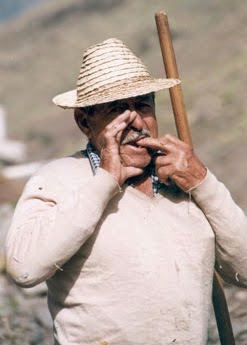
El silbo gomero

Source: http://www.gevic.net/info/contenidos/mostrar_contenidos.php?idcat=42&idcap=112&idcon=102

I created a cultural reading on "El Silbo" the language used by the inhabitants of La Gomera. The "silbo" is a whistled language used to to communicate across the deep valleys and ravines on the island of La Gomera in the Canary Islands.


El silbo

Teaching Esperanza / Guatemalan Civil War / Personal Reaction

I am currently teaching Carol Gaab's novel Esperanza to my 8th graders. The novel has been a real hit with students and I am particularly fond of it because of the potential for really rich cultural and historical study. It doesn't hurt that there are a ton of resources out there from some very creative teachers for use with the novel. For example, Martina Bex has a ton of beautifully designed graphic organizers aligned to each chapter. The teacher's guide is packed with excellent teaching ideas (among my favorites is the simultaneous acting which I intend to blog about later) and a thorough supplement of presentations on Guatemalan history, culture, family, and traditions. Finally, the Language Educator recently published an article by Carrie Toth on using the novel to develop global awareness. We have just completed chapter four of the novel and my students are really excited as this is when the action sets in. I've used the teacher's guide and the novel in order to facilitate some pretty interesting conversations regarding justice and injustice, worker's unions, and the right to strike but, I wanted my students to know more about of the history of the Guatemalan Civil War, in order to give the events in the novel more of a meaningful, historical context. This was a tricky thing to do for various reasons. The first biggest challenge was that the Guatemalan Civil War was an extremely long, violent, and inhumane conflict throughout which the United States did not play a particularly sympathetic part. The second problem was that I teach middle school and I didn't want to derail the unit on Esperanza into a far too sophisticated exploration of the causes of the Guatemalan Civil War. Finally, I had to keep it comprehensible. Aware of these potential pitfalls, I began searching for resources that would let me develop a comprehensible explanation of the causes of the Guatemalan Civil War without overwhelming my middle schoolers. Below are some of the best resources I found in my search:


From these resources I pieced together this PPT presentation that made use of the vocabulary structures we were studying (these structures were taken directly from the novel).
The problem then became, how do I present this to 8th graders? My objectives were threefold: To have students understand some of the causes of the Guatemalan Civil War in order to give the novel some historical context. To reinforce the vocabulary structures we were learning in class by providing comprehensible input. Finally, to have students understand and recognize "injusticias." Below is an outline of the lesson I taught.

1. I had students write down the words "justo" and "injusto" with their English definitions in their notes. Then, I projected a series of sentences like "Hay una fiesta y solo los que lleven camisas rojas pueden ir" on the board and called on students to identify each as either fair or unfair. (This activity was taken directly from the Teacher's Guide to the novel.)

 2. I then showed the class a three minute clip from the film, When the Mountains Tremble, in which Rigoberta Menchú describes her experiences working on the sugar plantations as a young girl. The clip also shows actual footage from the worker's movement in Guatemala and the military's decision to crack down on this movement. The clip runs roughly from 1:10 to 1:07 of the film. During our viewing I paused and asked students whether events were "justo" or "injusto" and had them explain.

 3. I then began to present them with the PPT. The presentation took two days. After the first day, I had them complete the reading below which is essentially the text from the presentation. I wanted them to read first before we discussed the presentation.


4. After finishing the presentation, I had students write a personal reaction to the history. I explained that a formal personal reaction should start with an explanation of what they had read/seen/heard. The next step was to describe the emotion that they felt when reading, viewing or hearing a description of the events. (I gave them guided questions and sentence starters to help them with this activity. For example, ¿Cómo te sentías cuando leíste el artículo, «La Guerra Civil de Guatemala»? Me sentía ... porque...) I then wanted the students to give me details and examples (detalles y ejemplos) and, finally, they were asked to make a personal connection to the text (¿Has experimentado / leído / oído de una injusticia?).

Oraciones completas

This year I'm "floating," meaning I'm without classroom and travel from room to room with a cart. Thankfully, the school has arranged it so that I don't have very far to travel (across the hall, two doors down, etc.). It has been a true lesson in efficiency and, since managing a classroom takes a lot of time and effort, it has freed up time for me to work on other things and it is where I work that I want to write about. I was given a desk in the back of another teacher's classroom (my old room) where I could lesson plan and grade papers. As it happens my planning and lunch period do not coincide with his and, as a result, I am often at my desk while he's teaching. While I won't speak for him, for me, this has been an fabulous opportunity for me to learn from my fellow teachers. I am picking up all sorts of strategies on classroom management, formative assessments and delivering instruction. Among these was a remark I overheard him make to his class the other day: "In this class, we always write in complete sentences." I know it might not sound like much, but as a novice Comprehensible Input language teacher, I've been primarily preoccupied with my students' comprehension and haven't focused as much on their productive skills. I often give comprehension questions in which the students are writing one word answers in either English or Spanish (this because my primary objective is to assess understanding) and it occurred to me that having them respond in complete sentences in writing would be a way of supporting productive skills while assessing comprehension.